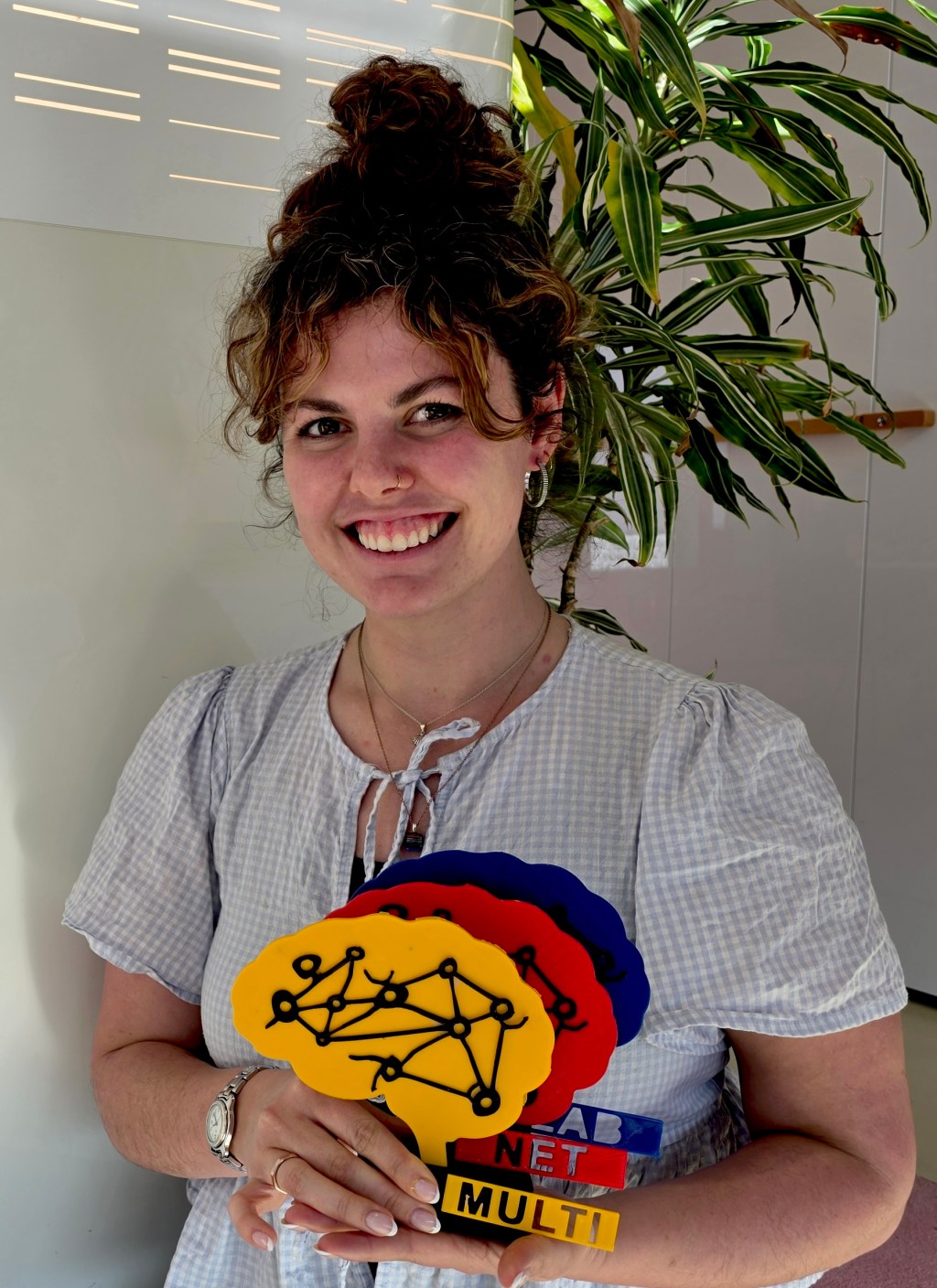
My name is Emma, and I am a PhD candidate in the MULTINET Lab. I completed my Bachelor’s degree in Cognitive and Behavioral Neuroscience at the College of Wooster (Ohio, USA). For my honors thesis, I used EEG to investigate how external facial features influence recognition accuracy when viewing same-race and other-race faces. This work explored mechanisms underlying the well-known Other-Race Effect, focusing on differences in encoding and retrieval processes that contribute to recognition discrepancies.
Although I was fascinated by the cognitive foundations of neuroscience, I became increasingly drawn to neuroimaging and the translational potential of brain research. I completed my Master’s degree at the Institute of Neuroscience of Alicante (Spain) in the Translational Imaging Biomarkers Lab, where I contributed to a project aimed at identifying early biomarkers of Alzheimer’s disease. Using structural MRI and immunohistochemistry, I examined volumetric changes at both macro- and microscales, integrating these measures to link structural alterations across levels of organization.
These experiences solidified my interest in translational neuroscience, particularly in understanding animal models that more closely reflect human neurobiological frameworks. Establishing methodologies and conceptual frameworks that span multiple scales is essential for improving the bidirectional translation between preclinical and clinical research.
In my PhD, I will be working with Linda, Dorien, Rachel, and Iza to examine behavioral and brain variation across different scales from healthy rats as part of the TRANSCEND consortium. Our goal is to better understand the biological basis of cognitive variability observed in highly heterogeneous conditions such as multiple sclerosis and autism. Using a reverse translational approach, we begin with macroscale network findings from human fMRI and move across scales to examine mesoscale population dynamics with miniscopes and microscale cellular architecture with histology. By integrating whole-brain connectivity, neural population activity, and cellular features within the same framework, we aim to establish multiscale patterns associated with autism and multiple sclerosis. Incorporating behavioral measures of impulsivity and cognitive control allows us to link these cross-scale neural signatures to individual differences in cognitive performance.
Traditionally, animal models are optimized to study single causes or treatments. As a result, in complex and heterogeneous conditions such as multiple sclerosis and autism, many relevant human readouts and multifaceted correlates of these disorders are often overlooked. This approach limits our ability to capture the diversity that is widely recognized in these conditions. Furthermore, because it is not feasible to measure brain organization across multiple scales in patients, the current literature lacks a comprehensive understanding of the multiscale neural features that may drive variability in behavioral outcomes. By characterizing natural variation across scales, we hope to provide a stronger foundation for understanding and interpreting the heterogeneity observed in complex neurological disorders.
I am so excited to be part of the MULTINET Lab and to collaborate within such an interdisciplinary and innovative research environment!


Leave a comment